There is courage in being soft.
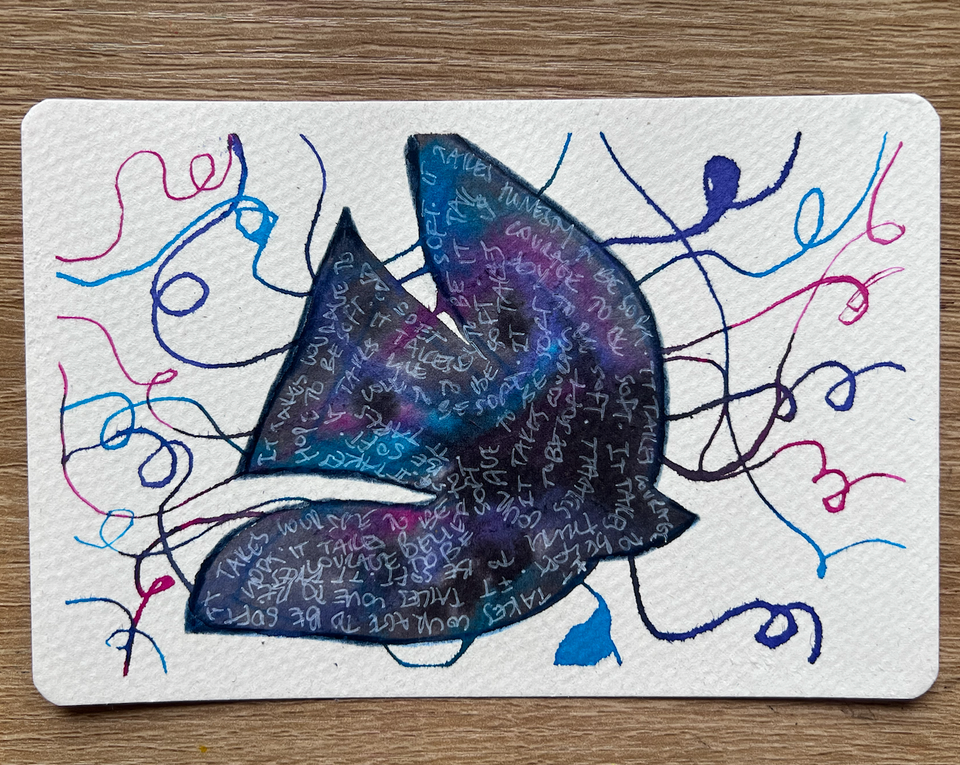
Apparently, I had more to say about being soft.
For those who don’t know me, I’ve worked at the intersection of humans and technology since I was about 25.
Before that, I thought I’d be an artist. My first degree was in Visual Arts. I loved making things, playing, and all the messy & creative stuff. It was my happy place.
Then I landed in business. And the message was pretty clear.
Less mess.
Less feelings.
Harden up.
You can’t be too honest in business. Or too creative. Or too human.
Instead, we get really good at smoothing out the mess. Performing, being productive and looking efficient. Corporate speak. Bullshit bingo. Saying everything except what we actually mean.
I spent a good part of my career quietly weaving the soft stuff back in. Creativity. Connection. Care. Because I came with a strong belief that you can grow profit AND care about people despite messages that challenged that belief.
And I’m still unlearning the idea that soft means weak. That mess is something to remove. That all the human stuff is somehow less commercial.
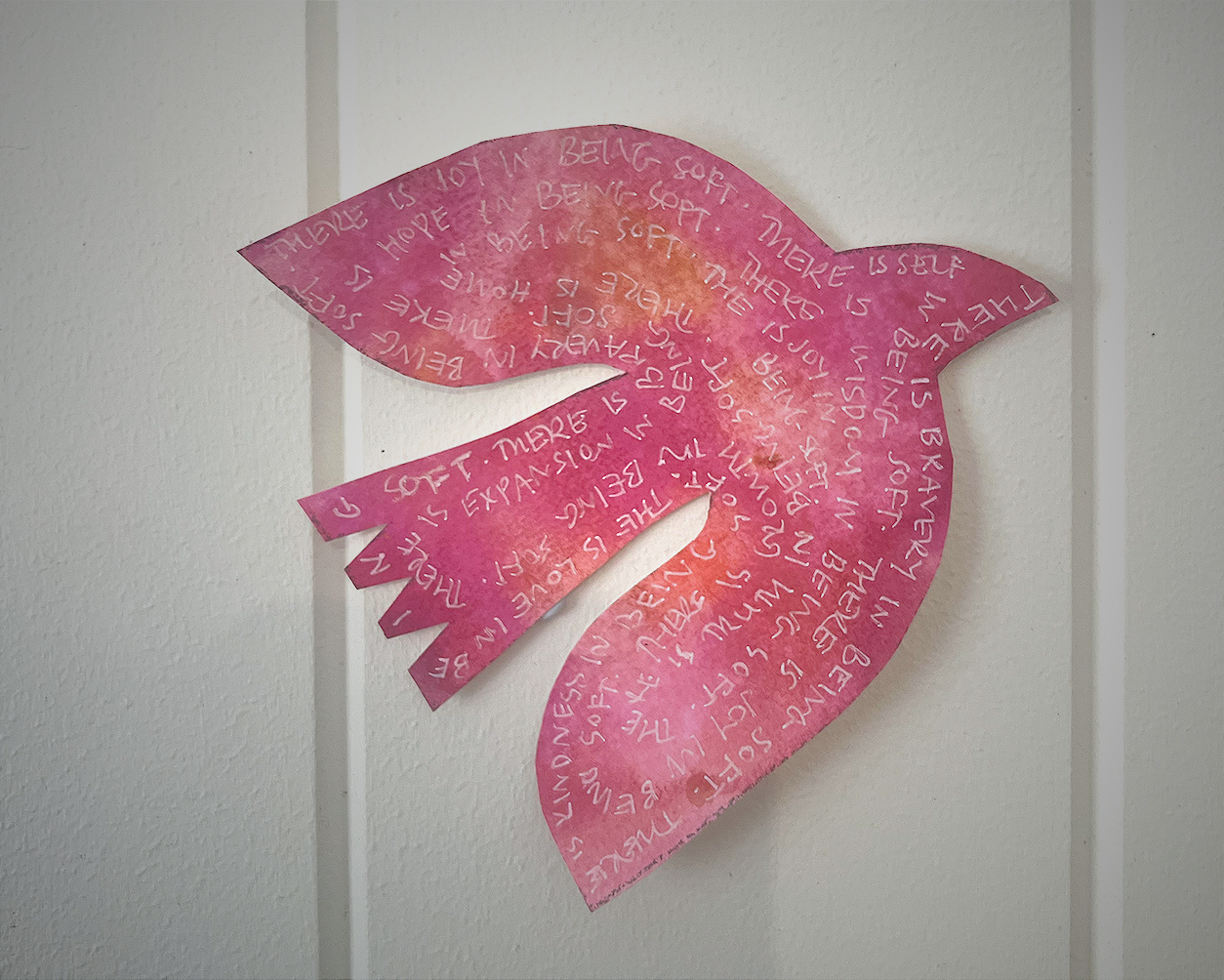
Lately, it looks like painting crows and writing a poem over and over again.
There is courage in being soft.
And the more I think about it, the more I wonder why we’ve spent so long trying to toughen it out of ourselves. Or maybe, why I listened.
A lesson in leading from love
I walked into business already feeling a little too soft for it. I know I brought my own bias to the experience, and that I probably saw some of my own fears reflected back at me.
Years later, I had the incredible privilege of becoming CEO. It was a role of a lifetime, and so much of that experience shaped me. One of the most important moments came early on.
I got to spend some time with the resident life coach. He'd been working with the business for more than 20 years and had created a safe space where anyone, regardless of their role, could book time with him to talk through just about anything.
He was a beautiful man. Kind, but with a healthy appetite for real talk. He didn't pull punches if he thought it would help you. Lucky for him (and me), real talk is my love language.
He said something I've never forgotten.
There are two types of people. Fear-led and love-led. And you are love-led. Don't ever stop being that. It will be hard, and you will need to dig deep. Because it is hard to lead from love in a world built around so much fear. But love is really the only way.
He was right and it was hard. Sometimes it meant being the person who said the thing nobody else wanted to say. Not because I thought I was right about everything. But because I felt an obligation to the other person to speak into what I could see.
I think of it as a practice. The art of caring. And it carries risk, because how the other person responds is never in your control.
I once told a founder that he didn't understand his own customer. He was taking hours of their time and then not giving them what they actually wanted. It was costing him millions in revenue. He looked at me and said, "Who the fuck do you think you are to tell me how to run my business?"
He held a lot of power in that room. And he wanted to rattle me. I said, "You know your business better than anyone. And I know how to solve that problem for you." He ended up working with me. And I did solve it.
That answer was a soft skill, too. Not defending myself. Not backing down. Just making room for his expertise and mine in the same sentence.
Fear-led might have kept me quiet in the first place. Love-led meant caring enough to say it anyway, and staying in the room while it was heard.
I've come to think that's what leading from love really means. Caring enough about someone to tell them the truth, and staying in the room while they hear it. That's not being a pushover. It's being willing to care about the outcome more than your own comfort.
The stuff nobody could count
For a long time, I thought I needed to develop a thicker skin. My bosses told me so often enough. And I started to believe the problem was my skin.
But I've come to wonder whether something else was going on. We created a hierarchy of skills. Technical skills were the real ones. The soft skills were nice to have. And the technical ones had a rather convenient advantage. You could measure them.
You can count sales, lines of code, units shipped and margin points. You can put them on a dashboard and reward someone for moving the number.
Try putting a number on the person who quietly stops a team from falling apart. The manager people stay for. The person who notices someone isn't okay and has the conversation nobody else will. The leader who creates enough trust for someone to admit they don't know the answer.
That stuff doesn't always show up on the dashboard. So it doesn't show up in the review. So it doesn't get rewarded or promoted. And eventually, it gets called nice to have. Not commercial.
I don't think we devalued these skills because they didn't create value. I think we devalued them because our systems struggled to see that value. Then we built whole careers and cultures around the things the system could see. And somewhere along the way, we got very good at measuring the work and rather less good at seeing the people doing it.
And now, the plot twist.
Now we're being told that soft skills are going to matter more than ever. Empathy. Judgement. Creativity. Connection. The ability to navigate ambiguity and work with other people. As AI takes on more cognitive work, these are the capabilities we're told will set us apart.
And I keep thinking about all the people who spent decades being told those things weren't the real work. Nobody's going back to apologise. Instead, we're apparently going to need to rediscover them. But here's what worries me. We spent a long time training these skills out of people.
Toughen up. Grow a thicker skin. Leave your feelings at the door.
Now we're handing more of the measurable work to machines, and the capabilities we're going to rely on are the very ones we've spent years overlooking. I'm not sure we can just switch them back on.
And if we roll AI into the same busy, KPI-heavy structures we already have, I suspect the time we save won't necessarily go towards more care or connection. It'll go towards more busy.
More meetings. More output. More things to measure.
The soft stuff gets squeezed again, just faster. Which feels like a rather spectacular missed opportunity. What if we used some of that time to be more human instead?
Soft, feminine, and why I'm not anti-masculine
Softness has often get's coded as feminine. I want to be careful here, because I'm not anti-masculine. Not even a little. I love drive. Structure. Protection. The willingness to hold a line and get things done. We need all of that.
This is about balance. About making space for the feminine in systems that have spent a very long time devaluing it. And by feminine, I don't mean women. We all have these capabilities, regardless of gender.
I've watched plenty of men in business who are deeply caring and who learned to hide it because it didn't seem to be what got rewarded. Or because they didn't want to risk being called soft.
A lot of us learned to hide the parts of ourselves that didn't fit the mould. And right now, some of the most powerful voices in tech seem to be reinforcing that message.
Elon Musk has described empathy as a weakness of Western civilisation.
Mark Zuckerberg has called for more aggression and masculine energy in business.
I'm interested in what happens when we celebrate one set of capabilities while treating another as a liability. Because softness isn't the opposite of strength. You can be compassionate and hold someone accountable. You can listen deeply and make a hard decision. You can care about people and have very high expectations of them.
In fact, I think those things can make each other stronger.
Meanwhile, the people building AI
Some of the people closest to this technology are reaching for a rather different idea. Mo Gawdat, the former chief business officer at Google X, has spoken about AI as our children: something we're raising, shaped by what we do as much as what we say. It's an interesting way to think about our responsibility.
What are we teaching it about being human?
And Geoffrey Hinton, often called the godfather of AI, has argued for AI with maternal instincts. AI that genuinely cares about us.
I find that fascinating.
Some of the loudest voices are telling us empathy is weakness, while some of the people who understand this technology most deeply are exploring the importance of care. I don't think that contradiction is neatly resolved. But I do think it's worth sitting with.
If we're building systems that will increasingly shape how we work, learn, live and connect, surely the qualities we want those systems to support should matter as much as what they can do.
And surely we should be practising those qualities ourselves, too.
Soft as rebellion
I've started to wonder if being soft is a small act of rebellion. Choosing to listen when the culture says push. Choosing care when the culture says aggression. Staying curious in a room that rewards certainty. Telling the truth when it would be easier to smooth things over. And refusing to play the game where winning is the only thing that matters, regardless of what it costs us.
Soft doesn't mean weak. And it definitely doesn't mean not angry. I'm pretty angry, actually. Softness can hold a lot of fire. It just chooses what to do with it.
The more I think about it, the more intentional I want to be about what I care about. Where I put my energy. What I make space for. What I refuse to harden against. I think the leaders who will matter most in the next ten years will be the ones who can hold both.
The edge and the care.
The drive and the softness.
The ability to make difficult decisions without losing sight of the people who live with them.
And do it all without apologising for either.
The crow
Here's a little practice I've started. I paint crows because I love how magical, fierce and beautiful they are. Then I write a little meditation.
There is courage in being soft.
I write it again and again, letting the words shift with whatever I'm feeling.
There is love in being soft.
There is power in being soft.
There is strength in being soft.
There is beauty in being soft.
There is impact in being soft.
It's a simple way to remind myself of the kind of woman I want to be in the world. Not harder. Not more polished. Not less messy. More myself.
Because the soft stuff isn't something I need to squeeze into the edges of my life. It's where some of the best parts of me live. And those are the parts I want more of.
What is your relationship with being soft?
Thanks for reading.
And if you'd like to share your thoughts, I'd love to hear them. Send me a voice note here or reply to this email.
Or connect on Instagram, Substack or LinkedIn.
Let's figure this out together.