The door we keep slamming
We've collapsed every conversation into two positions.
You're in or you're out. With us or against us. Right or wrong.
And we wonder why nothing moves.
It's not a new problem. But it's getting louder. Social media didn't create binary thinking — it just handed it a megaphone and a reward system. The more certain you sound, the more you're seen. Nuance doesn't travel. Doubt doesn't get shared. So we perform our positions instead of examining them, and the distance between us grows.
I grew up in a house where disagreement meant someone was wrong. Full stop. No room for questions. Just positions, and the door slamming on the way out.
It took me a long time to understand that wasn't just a family pattern. It's a human one. And we're all running it right now, collectively, at scale.
Thirty years in rooms where people had to think together taught me something different. Disagreement is often where the best outcomes start. The problem was never the disagreement. It was leaving the room.
What opens thinking up. What closes it down.
Entrenched opinions — and the unwillingness to stay — almost always close it down.
This weekend I ran an experiment on myself.
One of my best friends holds views on something that matters deeply to me that look, on the surface, almost opposite to mine. We've been circling this conversation for years. Approaching it. Retreating. Neither of us ready to go there properly.
This time I gave myself one constraint: just curiosity.
Not to change his mind. Not to defend mine. Just to understand how he got there.
What shaped his view? What experiences led him there? What was he actually trying to protect?
He reflected the same curiosity back.
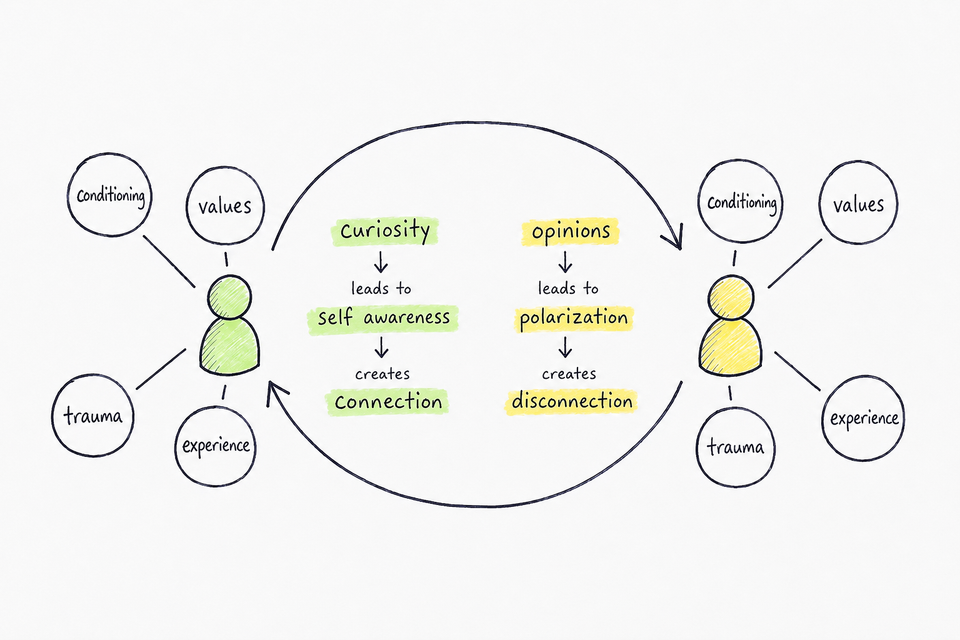
We didn't change our minds. But something shifted. In both of us. Curiosity about where someone else landed makes you curious about where you landed. You start pulling at your own thread.
Our opinions aren't random. They come from conditioning, experience, values. Sometimes from old wounds. The louder the conviction, the more it's worth sitting with.
I sat with mine. And found more complexity than I'd admitted to myself.
We reach for empathy as the antidote to polarisation. I've done it too. But I'm starting to wonder if curiosity gets there faster.
Empathy asks you to feel what someone else feels. That's a big ask when you genuinely disagree. It can tip into performance — nodding along while privately holding your ground.
Curiosity asks a simpler question: how did you get there?
It doesn't require you to agree. It doesn't require you to soften your position. It just requires you to be genuinely interested in the answer. And that interest, it turns out, has a way of changing the shape of the conversation without either person having to back down.
Turns out we weren't as far apart as I thought. Not because one of us conceded. We'd both missed the real story, hidden in the layers. Once we found it, the surface opinion became less important.
The practice I'm sitting with this week:
Notice when you reach for a position instead of a question. Not to abandon what you think — but to get genuinely curious about how the other person got where they landed. And then, if you're willing to go further, get curious about how you got where you landed.
The door doesn't have to slam. That's a habit, not an inevitability.
Where do you find yourself reaching for a position when a question might open something up instead?
I'd genuinely love to know.
— Jane